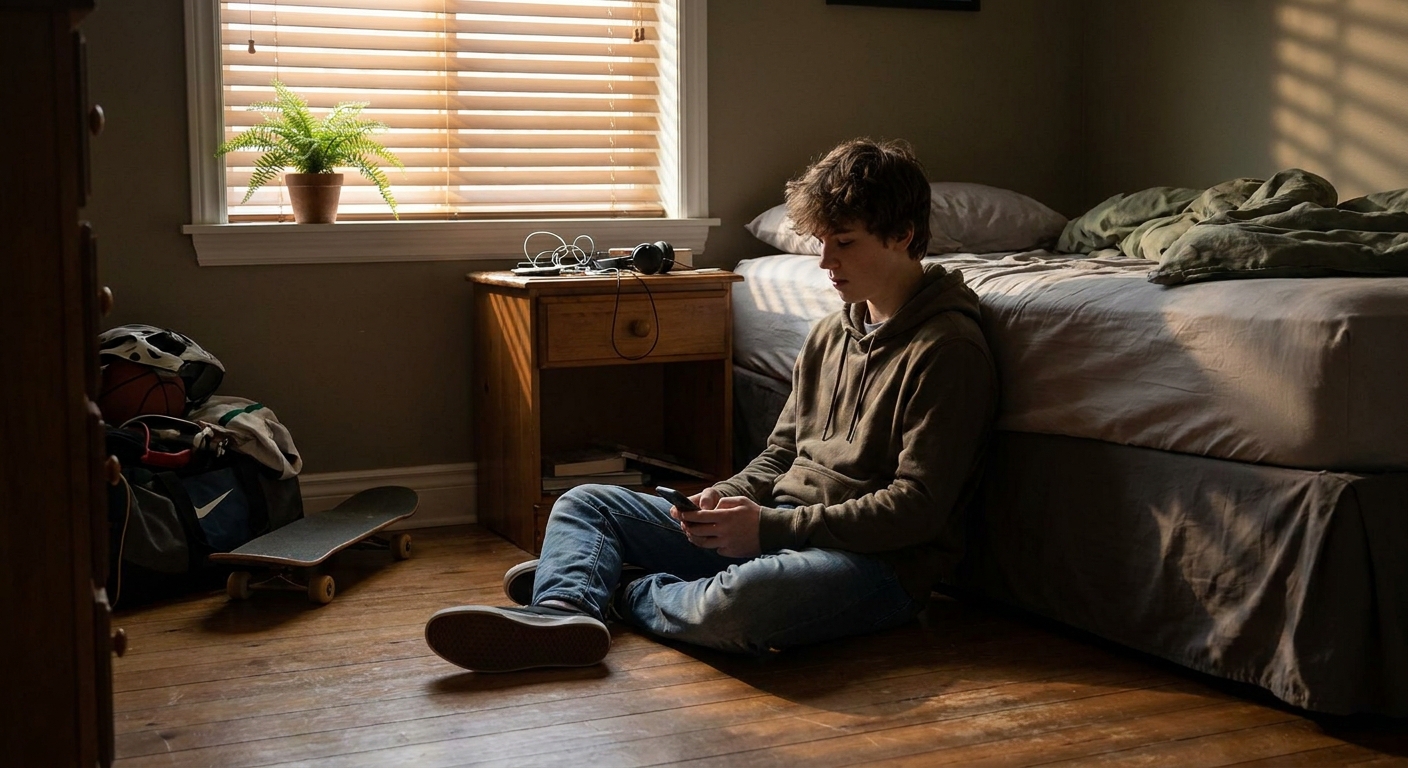
You keep trying to find the day it started. Maybe it was the fall of seventh grade, when the sports bag stopped coming out of the closet. Maybe it was the spring of freshman year, when the bedroom door started staying shut and dinner turned into one-word answers. You replay it the way you would replay a near miss on the freeway, looking for the moment you should have hit the brakes. You cannot find one, because depression in teens almost never shows up on a single day. If you have been typing “what age is depression most common in teens” into a search bar late at night, you are not looking for trivia, and Centered Health knows that. You want to know whether what you see in your own kid is normal growing up or something that needs help, and whether you have already waited too long.
Here is the short answer. Depression gets more common with every year of adolescence, and the risk climbs fastest in the early teen years, roughly ages 12 to 15. Many first episodes begin in that stretch. It is a critical window, and knowing what it looks like may help you notice earlier.
If you are reading this because your teen is talking about suicide, has hurt themselves, or you believe they are in danger right now, stop here and call or text 988, or call 911. Everything below can wait until your child is safe.
This guide comes from Centered Health, a Culver City behavioral health provider offering personalized evidence-based care at three intensive levels: residential, partial hospitalization (PHP), and intensive outpatient (IOP), along with outpatient therapy. Our clinical team treats depression alongside anxiety, trauma, PTSD, OCD, suicidal ideation, eating disorders, and substance use disorders. This guide covers when depression usually begins, how it looks at different ages, why families wait, and how to match your teen to a level of care.
What Age Is Depression Most Common in Teens, and Why Do the Early Teen Years Matter So Much?
Depression is more common in older teens than in younger ones, but the steepest rise in risk usually happens between about 12 and 15. That is why the early teen years are a window to watch closely.
The broad picture is serious. The World Health Organization estimates that one in seven young people ages 10 to 19 experiences a mental disorder, with depression and anxiety among the leading causes of illness in this age group. The same WHO fact sheet shows depression is more common among 15 to 19 year olds than among 10 to 14 year olds. So the honest answer has two parts. The later teen years carry the most depression overall. The middle school and early high school years are when much of it starts.
Why that window? Because several things pile on at once. Puberty brings hormone shifts that affect mood and sleep. The emotional parts of the brain mature faster than the parts that handle planning and self-control, so feelings run hot before the brakes are fully built. Friend groups break apart and re-form, often more than once. Schoolwork gets harder, and grades start to feel like they count. Sleep patterns shift later while school start times stay put. Any one of these is manageable. All of them together, for a kid who also carries some family history, a painful experience, or a naturally anxious temperament, can contribute to a clinical episode.
Researchers who study youth depression have found that before puberty, rates in girls and boys look fairly similar, and the gap opens up during early adolescence, when girls become noticeably more likely to experience depression. Boys are not off the hook. Their depression can simply be easier to miss, which the next section covers.
What this means for you: if your child is 11, 12, or 13, this is a time to pay attention, not to panic. Notice patterns. Keep talking. Treat a lasting change in mood the way you would treat a cough that will not go away. You would not wait for pneumonia before calling the pediatrician.
How Does Depression Look Different at 13 Than at 17?
Younger teens with depression often look irritable, restless, or physically sick. Older teens are more likely to withdraw, oversleep, and say out loud that things feel hopeless. Girls and boys can also show it in different ways.
This surprises a lot of parents. Most of us picture depression as sadness and crying, but in younger teens it often looks like anger. The DSM-5, the manual clinicians use to diagnose mental health conditions, recognizes this directly: in children and teens, an irritable mood can stand in for a sad mood when diagnosing a depressive episode. So the 13-year-old who snaps at everyone, slams doors, and says “nothing” when you ask what is wrong may not be going through a phase. They may be telling you something in the only language they have right now.
Here are signs that commonly show up at different ages and in different teens:
- Younger teens (about 12 to 14) often complain of headaches or stomachaches, especially on school mornings, and may ask to stay home more often than before.
- Younger teens also tend to show irritability, short tempers, and big reactions to small frustrations instead of obvious sadness.
- Younger teens may quietly drop activities they used to love, like a sport, an instrument, or a club, and give vague reasons.
- Older teens (about 15 to 17) more often pull away from family and friends, spend long hours alone in their room, and sleep far more than usual, including on weekends and after school.
- Older teens are more likely to say hopeless things directly, such as “what’s the point” or “nothing is going to get better,” and may talk about being a burden.
- Older teens may start experimenting with alcohol, vaping, or other substances as a way to numb out or fall asleep.
- Girls more often turn the pain inward: guilt, harsh self-criticism, body image worries, changes in eating, and replaying social conflicts over and over.
- Girls may also hide symptoms behind good grades and a busy schedule, which can make depression easy to miss until they hit a wall.
- Boys more often turn it outward: anger, risk-taking, fights, reckless driving, or sudden trouble at school.
- Boys may say “I’m fine” right up until they are not, and they are often less likely to name sadness even when they feel it.
These are patterns, not rules. Plenty of girls get angry and plenty of boys cry. The point is to look at the whole picture over time, not one bad day.
When you reach out for an assessment, the most useful thing you can bring is a simple timeline. Note when you first noticed a change, what it looked like, and whether it is getting better, staying the same, or getting worse. A 13-year-old with stomachaches and a 16-year-old who sleeps 14 hours on Saturday may be dealing with the same condition, but their care plans, peer groups, and family involvement can look very different. Personalized evidence-based care at Centered Health accounts for that.
Why Do So Many Parents Wait, and What Does Waiting Cost?
Most parents wait because depression creeps in slowly, and they are watching for a crisis that never announces itself. The cost of waiting is not blame. It is fewer options.
Let’s name the hard part. You may be sitting with guilt right now, wondering how you missed it, wondering if you made it worse, wondering what kind of parent needs a search engine to tell them their kid is struggling. That guilt makes sense, and it is also not accurate. Teen depression can be hard to spot, and your teen may be working hard to keep it from you. Moodiness, extra sleep, and pulling away from parents are all normal parts of adolescence too, so of course you second-guessed yourself. Nobody hands you a line where normal teen stuff ends and clinical depression begins.
Here is a useful line, though. Clinicians generally look for symptoms that last at least two weeks, show up most days, and interfere with school, friendships, sleep, eating, or daily life. If you see that, an assessment is warranted. You do not need to wait for a bigger sign.
So why does timing matter? Depression caught early can sometimes be addressed with less intensive care, such as outpatient therapy or an intensive outpatient program, while your teen stays at home and in school. When depression goes on long enough to produce self-harm, suicidal thinking, school refusal, or a full academic collapse, safety has to come first, and that usually means a higher level of care like PHP or residential. Waiting does not make you a bad parent. It just takes choices off the table.
If you are wondering what you can do to help your teen with depression this week, start here:
- Write down what you have seen. Note dates, behaviors, sleep changes, grades, and anything your teen has said that worried you. This becomes your roadmap for every professional you talk to.
- Talk calmly and privately. Pick a low-pressure moment, like a car ride. Say what you have noticed without accusing. “You’ve seemed really worn down lately, and I’m worried about you” goes further than “What’s wrong with you?”
- Ask directly about suicide. Mental health professionals widely agree that asking a teen plainly whether they have thought about killing themselves does not put the idea in their head. It opens a door.
- Secure anything dangerous. Lock up or remove medications, firearms, and alcohol in the home, even if your teen has said nothing about self-harm.
- Schedule a medical checkup. A pediatrician can rule out physical causes like thyroid problems or anemia and can be part of the care team.
- Call for a professional assessment. A behavioral health provider can tell you what level of care fits what you are seeing, which is often the question keeping you up at night.
- Get support for yourself. You cannot carry this alone. Lean on a partner, a friend, or a therapist of your own. Your steadiness is part of your teen’s treatment.
Depression Rarely Comes Alone, So Why Would You Treat Only the Sadness?
Once you start looking closely, you often find that depression is not the whole story. Many teens with depression are also dealing with anxiety, trauma, substance use, an eating disorder, or OCD, and treatment may work better when it addresses all of it, not just the most visible symptom.
Think of a mechanic who resets your dashboard warning light without ever going under the hood. The light goes off for a week and then comes right back, because the problem was never the light. Depression works the same way. One teen might have lived with years of untreated anxiety before the low mood set in. Another might be carrying trauma from something they have never told anyone. A third might be vaping or drinking to get through the day, and the substance use is now making the depression worse. If treatment only targets the mood, the underlying drivers stay in place.
That is why Centered Health treats mental health and substance use together. Our team works with depression alongside anxiety, trauma, PTSD, OCD, eating disorders, suicidal ideation, and substance use disorders, so your teen does not get split between different programs for different problems. You can learn more about our approach at Centered Health.
So what is one approach to adolescent depression? Evidence supports structured talk therapy, with skills-based approaches like cognitive behavioral therapy and interpersonal therapy among the most studied. For moderate to severe depression, some teens may benefit from therapy combined with medication prescribed and monitored by a psychiatric provider. Family involvement matters a great deal, because a teen goes home to the same household every night, and that household can either reinforce what they learn or work against it. No single method works for every teen. Treatment is often most helpful when matched to your teen’s age, symptoms, co-occurring conditions, and family situation, and adjusted as they respond.
At Centered Health, personalized evidence-based care is built from four therapy formats working together: individual therapy, group therapy with peers, family therapy, and multifamily therapy, plus innovative therapies that go beyond conventional talk sessions. Multifamily therapy is worth knowing about. Several families meet together with a clinician, so you hear from other parents going through the same thing, and your teen sees other teens and their families doing the work. For many parents, that room is the first place they stop feeling alone.
Which Level of Care Does Your Teen Actually Need in Culver City?
Once you understand what is driving your teen’s depression, the next question is how much support they need. The answer depends on three things: how safe your teen is, how much depression is disrupting daily life, and how they have responded to less intensive help. Care runs along a continuum, and moving up or down as symptoms change is normal.
Here are the main types of depression treatment available for teens:
- Outpatient therapy usually means one or two sessions a week with a therapist. It fits teens with mild to moderate symptoms who are still mostly functioning at school and home.
- Intensive outpatient (IOP) usually means a few hours of treatment on several days each week, often scheduled around school. Your teen lives at home and gets more support than weekly therapy can provide.
- Partial hospitalization (PHP) usually means treatment for most of the day on most weekdays, with your teen going home at night. It fits teens whose symptoms make a normal school day impossible but who are safe at home overnight.
- Residential treatment means your teen lives on site in a structured treatment setting with around-the-clock support. It fits teens whose symptoms, safety concerns, or co-occurring conditions need more than a few hours of care a day.
Can a 15-year-old go to a mental hospital? Yes. A teen in immediate danger, such as after a suicide attempt, should go to a hospital emergency department, and minors can be admitted for psychiatric care. Residential treatment is different. It is not a hospital, but a structured, therapeutic setting for teens who need more support than outpatient care can give and who are not in an acute medical emergency. It may be a fit when outpatient or IOP has not been enough, when your teen cannot stay safe or function at home between sessions, or when several conditions are tangled together and need daily attention.
Here is how an adolescent depression treatment program generally works. It begins with an assessment that looks at symptoms, safety, history, co-occurring conditions, and family situation. That assessment points to a starting level of care. From there, your teen follows a structured schedule that mixes individual sessions, group therapy, and family work. In residential care, the day runs on a set rhythm, with staff present the whole time. Centered Health provides 24/7 observation in residential care, so your teen is never alone through a hard night. The setting matters too. Our serene Southern California environments are designed to feel calm rather than clinical, because a teen who feels safe is a teen who starts to open up. As your teen stabilizes, the team reassesses, and the plan changes with them.
Stepping down is where a lot of families get lost. Because Centered Health offers residential, PHP, and IOP, along with outpatient therapy, your teen can move from one level to the next without starting over with strangers. One possible path might involve starting in residential, moving to PHP as symptoms ease, then continuing in IOP while returning to school, though the pace and sequence of personalized evidence-based care vary widely based on each teen’s response to treatment. Our Centered Health utilization review team works with your insurance carrier along the way, documenting clinical necessity so each level of care matches where your teen actually is.
Because we at Centered Health are based in Culver City, families across the area can reach the full continuum of care close to home. That matters when you want to be at family sessions and part of your teen’s daily progress.
You may also be afraid your teen will refuse to go or will want to quit after a few days. That fear is common, and it is fair. Most teens do not walk into treatment eager. Resistance at the start does not mean treatment will fail. An experienced team plans for it by building trust, giving teens a voice in their own care, and keeping parents involved through family and multifamily therapy so the message at home matches the message in treatment.
And if you have already tried other programs and watched them fall apart, you are probably terrified of choosing wrong again. That makes complete sense. The questions worth asking any program are simple: Who will my teen see every day? How often will I hear from the clinical team? What happens if my teen gets worse? A program worth trusting will answer all three without hesitating.
Will Insurance Cover Teen Depression Treatment, and How Do You Find Out Before Day One?
Coverage depends on your specific plan and on clinical necessity, meaning whether your teen’s symptoms justify a given level of care. Centered Health’s insurance advocacy team contacts your carrier to review your benefits so you understand where you stand before treatment begins.
For a lot of families, money is the reason they have not called yet. It is not that they would not do anything for their kid. It is that they do not know what they are walking into. Will the deductible reset? Is residential included? What happens if the insurance company decides two weeks is enough? That uncertainty keeps people stuck on the sidelines.
Centered Health accepts six commercial and military plans: Aetna, Anthem, Blue Cross Blue Shield, Magellan Health, TRICARE, and UnitedHealthcare. Accepting a plan is not the same as guaranteeing what it will pay, and every policy is different. That is exactly why insurance advocacy matters. Our Centered Health team works directly with your carrier to review your behavioral health benefits, your deductible, your co-pay or coinsurance, and which levels of care your plan includes, then explains it to you in plain language.
Once your teen is in treatment, utilization review continues that work. Insurance carriers often approve care in blocks and ask for clinical updates before approving more. Our Centered Health utilization review team handles that communication and documentation, so you are not the one on hold with an insurance company while your teen is in treatment. Your attention belongs with your child.
To make the first call faster, have your insurance card ready, along with the policyholder’s name and date of birth, your timeline of symptoms, any past diagnoses or treatment, and a list of current medications. That is enough to get started.
Questions Culver City Parents Ask Before They Call
What age is depression most common in teens?
Depression is more common among older teens, around 15 to 19, than among younger ones. The sharpest rise in risk usually happens between about 12 and 15. Many first episodes begin then, which is why those years are a critical window for parents.
What are the early signs of depression in a 13-year-old versus a 17-year-old?
Younger teens often show irritability, anger, and physical complaints like stomachaches before school. Older teens more often withdraw from friends and family, sleep excessively, and say hopeless things directly. At either age, you may also see changes in grades, appetite, or interest in activities they used to enjoy.
How long should I wait before calling a treatment center if I think my teen is depressed?
Do not wait for a crisis. If symptoms have lasted around two weeks or are interfering with school, friendships, sleep, or daily life, it is time for an assessment. Calling earlier may keep more treatment options available.
What is the difference between outpatient therapy, IOP, PHP, and residential treatment for teens?
Outpatient is usually weekly therapy. IOP adds a few hours of treatment on several days a week while your teen lives at home. PHP is treatment for most of the day on most weekdays, with nights at home. Residential is around-the-clock care with 24/7 observation in a structured treatment setting when symptoms or safety concerns need more support.
Does insurance cover residential or PHP treatment for teen depression in California?
It depends on your plan and on clinical necessity. Centered Health accepts Aetna, Anthem, Blue Cross Blue Shield, Magellan Health, TRICARE, and UnitedHealthcare, and our insurance advocacy team reviews your benefits with your carrier so you know what your plan includes before treatment starts.
How quickly can my teen start treatment at Centered Health in Culver City?
Timing depends on the assessment, your insurance benefits, and current program availability. The fastest path is to call, share what you have been seeing, and let the admissions team tell you what is open now and what the next steps look like.
You Do Not Need Certainty to Make the First Call
If your teen is showing signs of depression, call Centered Health in Culver City for a confidential assessment and insurance verification. Personalized evidence-based care is available at residential, PHP, and IOP levels, and our team will help you understand what your plan covers before your family takes the first step.
Before you pick up the phone, write down two things: the month you first noticed a change, and the one moment since then that scared you most. Those two details tell a clinician more about a level of care than almost anything else, and they turn months of quiet worry into a starting point.
We’re Here When You Notice the Signs
If you’ve recognized some of these patterns in your teenager, you’re not alone in wondering whether it’s time to reach out for support. At Centered Health, we work with families in Culver City to understand what’s happening beneath the surface and create a path forward that feels right for your teen. A conversation with our team can help you sort through what you’re seeing and what might help.
This article is for educational purposes and is not a substitute for a professional evaluation. If your teen is in immediate danger, call or text 988 or call 911. Individual results vary; no treatment approach works the same way for everyone.