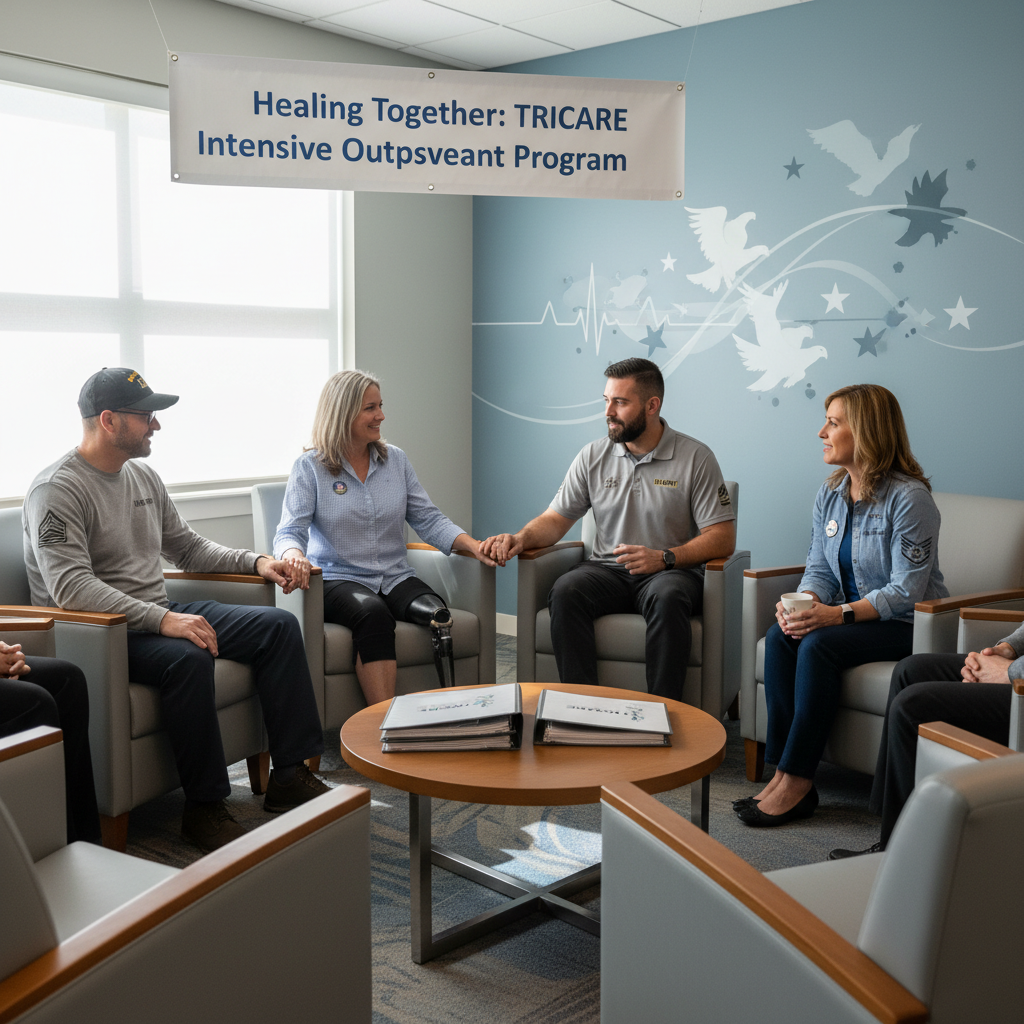
Understanding the TRICARE intensive outpatient program
If you are an active-duty service member or veteran, you may reach a point where standard counseling is not enough, but you do not need or want to stay in a hospital. This is where a TRICARE intensive outpatient program, often called an IOP, can be a good fit.
A TRICARE intensive outpatient program provides structured, multi-day treatment for mental health, trauma, or substance use issues while you continue to live at home. You attend therapy several days per week, participate in group and individual sessions, and receive coordinated care from a multidisciplinary team. Programs like the Intensive Outpatient Program at Alexander T. Augusta Military Medical Center in Fort Belvoir are designed specifically for active-duty personnel who need intensive treatment but do not require inpatient hospitalization [1].
For many military members and veterans, this level of care offers a balance. You can get more support than traditional outpatient sessions, but still maintain your responsibilities at home and, in many cases, at work.
How an intensive outpatient program works
Although every facility structures its days a bit differently, TRICARE intensive outpatient programs share several core features.
You typically attend the program on weekdays for a set number of weeks. For example, the Behavioral Health Intensive Outpatient Program (BHIOP) at West Bragg runs for 5 weeks, with group sessions Monday through Thursday from 8:00 a.m. to 12:00 p.m., plus one weekly individual therapy session. After the main phase, you participate in 4 weekly aftercare groups to support your transition back to regular outpatient care [2].
At Alexander T. Augusta Military Medical Center, the IOP operates Monday through Friday from 7:30 a.m. to 4 p.m. and is time limited. It focuses on improving your ability to function at home and at work through milieu groups, activities, and individual interactions with staff [1].
Across TRICARE covered IOPs, you can expect:
- A clearly defined weekly schedule
- Structured group therapy with other service members or veterans
- Regular individual therapy sessions
- Psychiatric evaluation and medication management as needed
- Support with coping skills, stress management, and relapse prevention
If you are looking into an iop that accepts tricare west, these are the types of services that are typically included.
The multidisciplinary team behind your care
One of the main strengths of a TRICARE intensive outpatient program is the range of professionals involved in your treatment. Instead of working with a single provider, you are supported by a coordinated team.
At Alexander T. Augusta Military Medical Center, the IOP uses a multidisciplinary team that can include psychiatrists, psychologists, advanced practice nurses, psychiatric nurses, social workers, licensed professional counselors, art and recreational therapists, and psychiatric technicians [1]. This range of expertise gives you access to medical, psychological, and practical support in one program.
Similarly, TRICARE Intensive Outpatient Programs at West Bragg are organized by specialty area. You can enroll in:
- A Behavioral Health IOP that focuses on mood, anxiety, and general mental health
- A Trauma Resilience IOP (TRIOP) that is trauma specific
- Addiction Medicine programs that target substance use and relapse prevention [2]
This structure means your care is not generic. Your team understands military culture, deployment history, and the unique stressors you face, and can build an individualized treatment plan around them.
PHP vs IOP: Key differences and how to choose
If you are exploring intensive treatment through TRICARE West, you will often see two main levels of structured outpatient care: Partial Hospitalization Programs (PHP) and Intensive Outpatient Programs (IOP). Understanding the differences can help you and your provider choose the best fit.
Level of intensity and time commitment
A Partial Hospitalization Program generally provides a higher level of care. You attend treatment most of the day, often 5 days a week, similar to a full-time workday. This level of structure is appropriate if you need more support than an IOP offers, but still do not require overnight hospitalization. If you are researching a partial hospitalization program tricare west, you are most likely considering this more intensive option.
An Intensive Outpatient Program requires fewer hours per week. You still attend several days per week and participate in multiple groups, but you have more flexibility to handle family responsibilities or a gradual return to duty. For many, an IOP functions as a step down from a tricare php mental health program or as a step up when standard outpatient sessions are not enough.
Daily structure and environment
PHP often includes:
- Full day blocks of therapy and skill groups
- Frequent psychiatric monitoring
- Close observation of safety and stability
IOP usually provides:
- Half day blocks, such as morning or afternoon sessions
- A mix of core groups and individual therapy
- Continued coordination with your command or workplace when appropriate
Both are considered structured outpatient treatment under TRICARE West, and both may fall within tricare west php treatment program or tricare west structured outpatient treatment benefits, depending on your plan and clinical need.
How to decide what you need
You might lean toward a PHP if:
- You are recently discharged from inpatient care and still need close monitoring
- Your symptoms make it hard to get through most of the day without intensive support
- Safety or crisis concerns are frequent or hard to manage on your own
You might lean toward an IOP if:
- You are stable enough to be at home without 24-hour supervision
- You can safely manage evenings and weekends outside of the program
- You need intensive support but must stay engaged with family or career commitments
In many cases, you might start in a PHP, then step down to an IOP, and ultimately transition to standard tricare outpatient mental health treatment once your symptoms are better controlled.
Specialized TRICARE IOP options for military and veterans
Not all intensive outpatient programs are the same. TRICARE recognizes that you may be seeking treatment for different reasons, and programs are structured to match those needs.
Behavioral health IOP
The Behavioral Health Intensive Outpatient Program (BHIOP) at West Bragg offers an intermediate level of care for service members who need more than traditional outpatient therapy. Over 5 weeks, you attend group sessions Monday through Thursday from 8:00 a.m. to 12:00 p.m., plus a weekly individual session, followed by 4 weeks of aftercare groups [2].
This type of program is a good fit if you are dealing with:
- Depression or anxiety
- Adjustment to life after deployment
- Sleep problems, irritability, or stress that impacts your functioning
When you are comparing options under behavioral health iop tricare west or a more general behavioral health outpatient program tricare, it helps to ask how the program handles military specific stressors, command communication, and return-to-duty planning.
Trauma-focused IOP
The Trauma Resilience Intensive Outpatient Program (TRIOP) at West Bragg is dedicated to trauma related conditions. It operates Monday through Thursday from 8:00 a.m. to 12:00 p.m., with one weekly individual therapy session of about 60 minutes, over 5 weeks. Afterward, you attend 4 additional weeks of once weekly aftercare groups [2].
TRIOP focuses on:
- Processing deployment related trauma
- Addressing symptoms of PTSD
- Building resilience, grounding, and coping skills
If trauma is a primary concern, a focused tricare therapy intensive outpatient program often provides a more targeted path to recovery than a general mental health track.
Addiction and substance use IOP
For substance use, TRICARE covered IOPs provide a higher level of care than traditional outpatient counseling. At West Bragg, the Addiction Medicine High-Intensity Outpatient Program (HIOP) runs Monday through Wednesday from 8:00 a.m. to 3:30 p.m. and Thursday from 8:00 a.m. to 12:00 p.m. over 5 weeks. It includes groups, individual sessions, sober support meetings, medication management, and medical labs [2].
After HIOP or residential treatment, you may move into the Addiction Medicine Intensive Outpatient Program (AMIOP) Aftercare. This open group runs for 4 weeks, with Monday, Tuesday, and Thursday sessions from 9:00 a.m. to 12:00 p.m. It combines group and periodic individual therapy, plus medication management and labs [2].
If you are comparing outpatient addiction treatment tricare west or tricare west outpatient addiction treatment options, these kinds of programs show how TRICARE IOPs can support both active treatment and ongoing recovery.
All TRICARE IOP services at West Bragg, including BHIOP, TRIOP, HIOP, and AMIOP, are located at the West Bragg Mental Health Intensive Outpatient Program in Building D-3145 on Merderet Street, Fort Bragg, NC 28310, with dedicated contacts for scheduling and questions [2].
How a TRICARE IOP supports your health and daily life
The structure of a TRICARE intensive outpatient program is not only about symptom reduction. It is designed to help you function better at home, at work, and in your community.
Improving your ability to function
Programs like the Intensive Outpatient Program at Alexander T. Augusta Military Medical Center are specifically focused on improving your functional ability at home and at work. Treatment includes groups, meetings, activities, and one on one interactions that help you apply what you learn to real life situations [1].
Throughout the program, you work on:
- Managing symptoms so you can handle your daily responsibilities
- Rebuilding relationships with family and peers
- Developing healthier routines and coping strategies
- Planning for a return to duty or transition to civilian life
Because IOPs are time limited and goal oriented, your team helps you set specific targets and track progress.
Balancing treatment with family or career responsibilities
For many service members and veterans, stepping away from duty or work for an extended inpatient stay is not realistic. IOP schedules are built with this in mind.
You attend treatment during set blocks of the day, then return home. This allows you to:
- Stay connected with your family
- Maintain some level of work or duty, when clinically appropriate
- Practice new skills in your real environment each evening
This balance is one reason many veterans choose Centered Health and other TRICARE approved programs for outpatient care. If you are looking into a veteran iop program tricare or a military outpatient mental health treatment tricare option, the ability to respect both your treatment goals and your responsibilities often becomes a deciding factor.
Accessing TRICARE covered IOP and PHP programs
Once you decide that a TRICARE intensive outpatient program might be the right level of care, your next step is understanding how to access it under your benefits.
TRICARE approval and referrals
Most intensive outpatient programs that serve military populations are already a tricare approved iop program. At facilities like Alexander T. Augusta Military Medical Center, appointments for the IOP are by referral only and the program runs Monday through Friday, 7:30 a.m. to 4 p.m. [1].
In practice, the process usually looks like this:
- You talk with your primary care manager or behavioral health provider about your symptoms.
- If they determine you need more intensive support, they submit a referral for a PHP or IOP.
- TRICARE reviews the request and authorizes the appropriate level of care.
- You are scheduled into a php treatment center tricare west or IOP slot once approved.
If you are already in standard tricare mental health outpatient treatment, your current therapist or psychiatrist can often help coordinate this referral.
Matching programs to your needs
When exploring options, it helps to clarify what you are looking for:
- If you want intensive therapy while staying at home, ask about an iop therapy program tricare west.
- If you need a higher level of supervision, or are stepping down from inpatient care, discuss a tricare php mental health program.
- If you are specifically interested in talk therapy or group based support, a tricare covered outpatient therapy program may meet your needs, either before or after an IOP.
For veterans, a veteran outpatient mental health program tricare that includes IOP or PHP levels can offer continuity of care as your symptoms change over time.
As you move through different levels of care, the goal is not to stay in the most intensive setting forever. Instead, your program should help you stabilize, build skills, and step down to less intensive tricare outpatient mental health treatment when you are ready.
Why veterans and service members choose intensive outpatient care
Choosing to enter an intensive outpatient program can feel like a big step. Yet for many veterans and active-duty members, it becomes a turning point in their health.
Here are some reasons you might consider a TRICARE intensive outpatient program:
- You want treatment that takes your military experience into account
- Weekly therapy has helped some, but not enough to change your day to day functioning
- You prefer to stay connected with family instead of entering inpatient care
- You need structure and accountability to follow through with recovery goals
- You value working with peers who understand deployment, reintegration, and military culture
If you decide that a structured program is right for you, exploring tricare west structured outpatient treatment options, from PHP to IOP, can help you choose a path that supports both your health and your responsibilities.
With TRICARE coverage, you do not have to choose between getting intensive help and maintaining your life outside the clinic. An intensive outpatient program is designed to give you focused, comprehensive care, while keeping you grounded in the roles and relationships that matter most to you.